Technical authority · When to use
When to use Chunking vs Reranking
Measure recall on required facts per question set first. If recall is low, change chunk size, overlap, and metadata boundaries before adding reranker latency and cost.
Short answer
Measure recall on required facts per question set first. If recall is low, change chunk size, overlap, and metadata boundaries before adding reranker latency and cost.
Clearest explanation
adequate· 58Canonical expert clip
Chosen for clarity and how directly it answers the question — not for views or hype.
Best expert explanation
"We're going to cover how to use Cohere's reranker to improve the final quality of your results"
Weights & Biases · End-to-end RAG architecture · 0:23
Opens a little earlier so you catch the setup
Share this moment
Share formats
Why this clip matters
Choosing between Chunking and Reranking changes your eval plan and ops surface — use practitioner tradeoffs before committing.
Choosing between Chunking and Reranking changes your eval plan and ops surface — use practitioner tradeoffs before committing. Signals: recognized expert channel.
Source credibility
Weights & Biases
RAG++ course: Hybrid search with Weaviate
0:23
Tutorial-style explanation — strong for concepts; confirm production details locally.
Decision rule
Measure recall on required facts per question set first. If recall is low, change chunk size, overlap, and metadata boundaries before adding reranker latency and cost.
Choose Chunking when
- • Recall@k is low because passages are too large, too small, or split mid-thought.
- • You are still designing ingestion and have no stable baseline metrics.
- • Required facts are missing from every retrieved candidate in eval traces.
Choose Reranking when
- • Recall is acceptable but precision at top ranks is noisy.
- • You can afford extra latency per query for a cross-encoder or rerank model.
- • Top-10 hits contain the answer but the wrong passage ranks first.
Production tradeoffs
- • Semantic chunking versus fixed token windows for technical docs.
- • Whether reranking belongs in-line or only in offline eval tooling.
Failure modes
- • Tuning rerankers while answers never appear in any chunk.
- • Huge chunks that bury the single sentence containing the fact.
Implementation mistakes
- • Buying reranker SaaS before baseline recall metrics exist.
- • Using fixed token windows on API reference docs with code blocks.
Related comparisons
Architecture visual
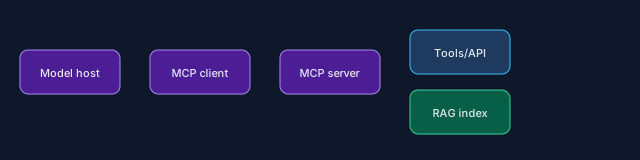
Semantic cluster
Semantic cluster: when to use chunking vs reranking
Related concepts
- • retrieval-augmented generation
- • chunking
- • embeddings
- • reranking
- • faithfulness eval
- • recall@k
Common misconceptions
- • Buying reranker SaaS before baseline recall metrics exist.
- • Using fixed token windows on API reference docs with code blocks.
Failure conditions
- • Tuning rerankers while answers never appear in any chunk.
- • Huge chunks that bury the single sentence containing the fact.
Tradeoffs
- • Chunking optimizes for one failure mode; Reranking optimizes for another.
- • Stricter faithfulness checks can reduce answer fluency.
When NOT to use
- • Do not force Reranking when required facts are not in the corpus.
- • Do not conflate tool protocol success with retrieval quality.
People also compare
Authoritative external references
- Model Context Protocol specification
Anthropic
Client/server/tool protocol for model hosts.
- Anthropic MCP announcement
Anthropic
Why MCP standardizes tool and data connections.
- OpenAI retrieval and embeddings guide
OpenAI
Grounding patterns and retrieval APIs.
What experts agree on
Practitioner themes behind this authority page — not a poll or quote list.
- •Both affect which text the generator sees — chunking upstream, reranking immediately before the prompt.
- •Both should be logged in eval traces to debug failures.
- •Retrieval quality dominates many production failures; fixing prompts alone rarely fixes wrong or missing chunks.
- •Chunking, embedding model choice, and metadata boundaries materially affect what the model can see.
- •Promoting the best passages after first-stage retrieval (reranking or hybrid scoring) often matters more than marginal prompt tweaks.
What experts disagree on
Open engineering debates — compare indexed explanations before you commit to an architecture.
Semantic chunking versus fixed token windows for technical docs.
Semantic chunking versus fixed token windows for technical docs.
Whether reranking belongs in-line or only in offline eval tooling.
Whether reranking belongs in-line or only in offline eval tooling.
Common mistakes
- •Tuning rerankers while answers never appear in any chunk.
- •Huge chunks that bury the single sentence containing the fact.
- •Buying reranker SaaS before baseline recall metrics exist.
- •Using fixed token windows on API reference docs with code blocks.
- •Treating RAG as a magic prompt wrapper without measuring retrieval recall on real questions.
- •Skipping chunking strategy because the context window is large.
Implementation tradeoffs
- •Chunk boundaries: Smaller chunks improve precision but fragment context; larger chunks improve local context but dilute relevance signals.
- •Reranking: Cross-encoder or LLM rerankers improve top-k quality at higher latency and inference cost.
Themes repeated across indexed engineering talks and practitioner writeups — not a survey, vote count, or attributed quote roundup.
Build a RAG investigation
Save expert explanations into one investigation, compare voices, and export a shareable research brief on this device.
Internal links
Continue with the product
Weekly digest of new expert moments
Programmatic access (waitlist)
Curated engineering collections
Browse hand-picked RAG and retrieval moments — same indexed corpus, organized for deep dives.
Open RAG explanation collection →Save clips to an investigation
Build a private notebook of timestamped moments while comparing RAG architecture choices.