Technical authority · When to use
When to use LangChain vs LlamaIndex
Pick LlamaIndex when the team’s center of gravity is document indices and query engines. Pick LangChain when the product is multi-tool agents and provider-swappable chains — then still own retrieval metrics.
Short answer
Pick LlamaIndex when the team’s center of gravity is document indices and query engines. Pick LangChain when the product is multi-tool agents and provider-swappable chains — then still own retrieval metrics.
Clearest explanation
adequate· 60Canonical expert clip
Chosen for clarity and how directly it answers the question — not for views or hype.
Best expert explanation
"How do you actually retrieve from a vector database and how do you synthesize that with an LLM"
AI Engineer · Foundational RAG explanation · 2:19
Opens a little earlier so you catch the setup
Share this moment
Share formats
Why this clip matters
Choosing between LangChain and LlamaIndex changes your eval plan and ops surface — use practitioner tradeoffs before committing.
Choosing between LangChain and LlamaIndex changes your eval plan and ops surface — use practitioner tradeoffs before committing. Signals: implementation or retrieval detail.
Source credibility
AI Engineer
Building Production-Ready RAG Applications: Jerry Liu
2:19
Practitioner explanation from an indexed engineering video — verify claims against your stack.
Decision rule
Pick LlamaIndex when the team’s center of gravity is document indices and query engines. Pick LangChain when the product is multi-tool agents and provider-swappable chains — then still own retrieval metrics.
Choose LangChain when
- • You combine LLMs with many external APIs and agent loops.
- • Team already standardized on LangChain patterns for production.
- • The product needs provider-swappable chains and tool-calling glue code.
Choose LlamaIndex when
- • Ingestion, indexing, and retriever configuration are the main product work.
- • You want higher-level query engines over heterogeneous document types.
- • Document loaders, node parsers, and index types are your daily work.
Production tradeoffs
- • Whether to keep orchestration in-application versus framework-managed agents.
- • How much ingestion logic belongs in ETL versus framework loaders.
Failure modes
- • Opaque default chunk sizes on technical PDFs.
- • Copy-paste tutorials without logging retrieved nodes.
Implementation mistakes
- • Switching frameworks to fix hallucinations without changing the index.
- • Skipping metadata on chunks (section, product area).
Related comparisons
Architecture visual
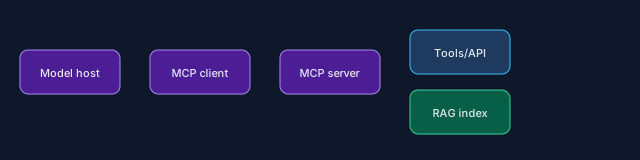
Semantic cluster
Semantic cluster: when to use langchain vs llamaindex
Related concepts
- • retrieval-augmented generation
- • chunking
- • embeddings
- • reranking
- • faithfulness eval
- • recall@k
Common misconceptions
- • Switching frameworks to fix hallucinations without changing the index.
- • Skipping metadata on chunks (section, product area).
Failure conditions
- • Opaque default chunk sizes on technical PDFs.
- • Copy-paste tutorials without logging retrieved nodes.
Tradeoffs
- • LangChain optimizes for one failure mode; LlamaIndex optimizes for another.
- • Stricter faithfulness checks can reduce answer fluency.
When NOT to use
- • Do not force LlamaIndex when required facts are not in the corpus.
- • Do not conflate tool protocol success with retrieval quality.
People also compare
Authoritative external references
- Model Context Protocol specification
Anthropic
Client/server/tool protocol for model hosts.
- Anthropic MCP announcement
Anthropic
Why MCP standardizes tool and data connections.
- OpenAI retrieval and embeddings guide
OpenAI
Grounding patterns and retrieval APIs.
What experts agree on
Practitioner themes behind this authority page — not a poll or quote list.
- •Both can call the same vector databases and embedding models.
- •Both can hide weak retrieval unless you log retrieved nodes explicitly.
- •Retrieval quality dominates many production failures; fixing prompts alone rarely fixes wrong or missing chunks.
- •Chunking, embedding model choice, and metadata boundaries materially affect what the model can see.
- •Promoting the best passages after first-stage retrieval (reranking or hybrid scoring) often matters more than marginal prompt tweaks.
What experts disagree on
Open engineering debates — compare indexed explanations before you commit to an architecture.
Whether to keep orchestration in-application versus framework-managed ag
Whether to keep orchestration in-application versus framework-managed agents.
How much ingestion logic belongs in ETL versus framework loaders.
How much ingestion logic belongs in ETL versus framework loaders.
Common mistakes
- •Opaque default chunk sizes on technical PDFs.
- •Copy-paste tutorials without logging retrieved nodes.
- •Switching frameworks to fix hallucinations without changing the index.
- •Skipping metadata on chunks (section, product area).
- •Treating RAG as a magic prompt wrapper without measuring retrieval recall on real questions.
- •Skipping chunking strategy because the context window is large.
Implementation tradeoffs
- •Chunk boundaries: Smaller chunks improve precision but fragment context; larger chunks improve local context but dilute relevance signals.
- •Reranking: Cross-encoder or LLM rerankers improve top-k quality at higher latency and inference cost.
Themes repeated across indexed engineering talks and practitioner writeups — not a survey, vote count, or attributed quote roundup.
Build a RAG investigation
Save expert explanations into one investigation, compare voices, and export a shareable research brief on this device.
Internal links
Continue with the product
Weekly digest of new expert moments
Programmatic access (waitlist)
Curated engineering collections
Browse hand-picked RAG and retrieval moments — same indexed corpus, organized for deep dives.
Open RAG explanation collection →Save clips to an investigation
Build a private notebook of timestamped moments while comparing RAG architecture choices.